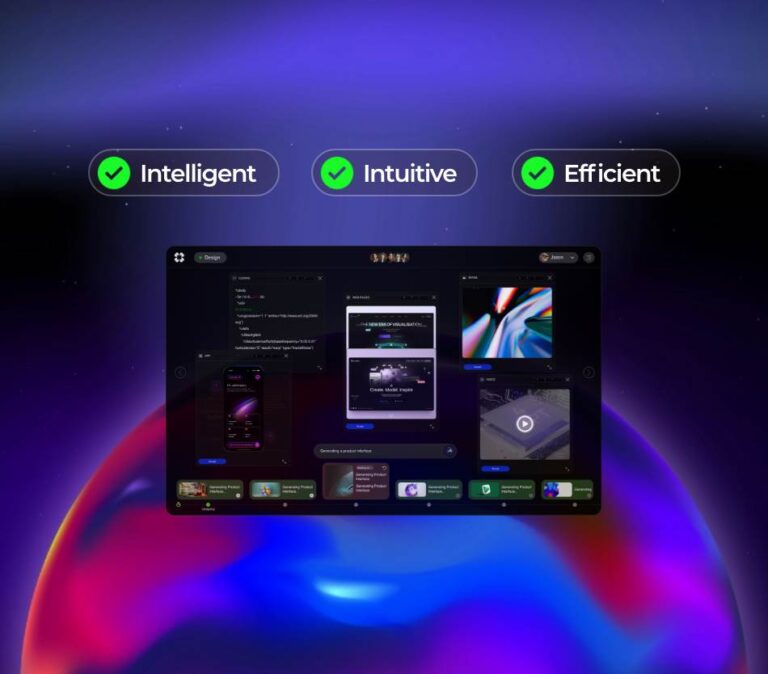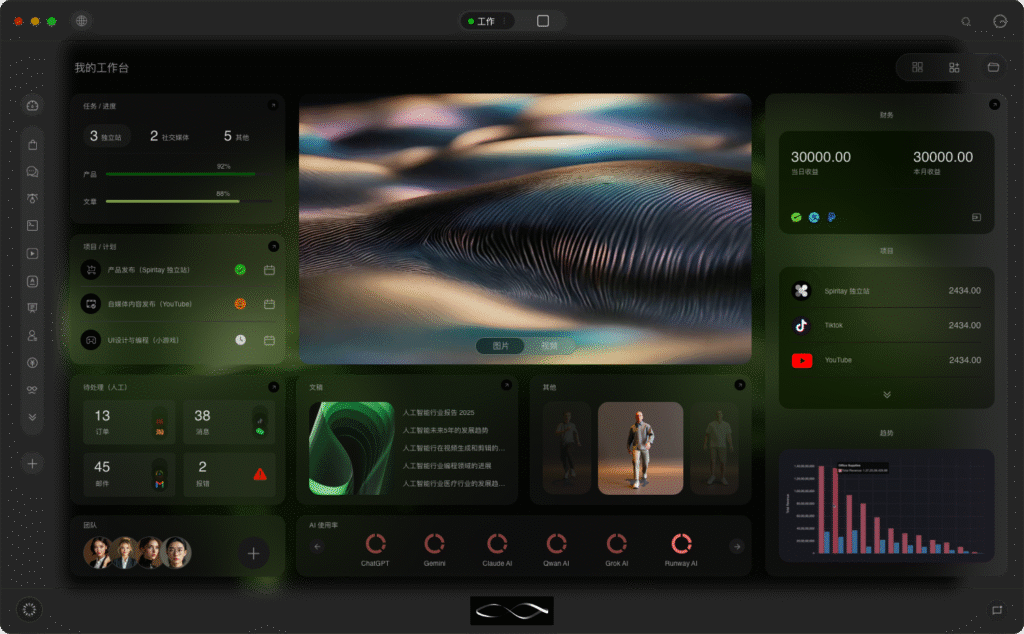

The term AI-powered multitasking OS evokes a single, unified platform where intelligent agents, workflows, models and integrations cooperate to automate many kinds of work. This article examines that idea end-to-end: what it means for different teams, how to design the architecture, which platforms and tools matter, and the operational trade-offs you must accept to get reliable, cost-effective automation in production.
Why an AI-powered multitasking OS matters
Imagine a small e-commerce company. Customer questions, returns processing, product descriptions and ad copy are all handled by different teams and point solutions. An AI-powered multitasking OS promises to unify these tasks: intelligent agents triage support tickets, model-powered workflows generate and A/B test product descriptions, and event-driven orchestration routes financial exceptions to human review.
For beginners, think of this OS as a smart control plane that coordinates many specialized tools. It listens to events (new order, support message, model alert), decides which component should act (agent, ML model, human), and ensures results are recorded, audited and routed correctly. The goal is higher throughput and lower manual toil while preserving safety and governance.
Core components and architecture
A practical AI-powered multitasking OS has a few recurring layers. I’ll describe each layer and why it exists.
1. Ingress and event bus
All inputs—user requests, webhooks, message queues, scheduled jobs—flow into a reliable event layer. Kafka, Pulsar, or cloud equivalents provide ordered, durable delivery. Use an event-driven model for non-blocking tasks and synchronous APIs for quick user-facing operations. Trade-off: event-driven scales well but requires idempotent tasks and more complex debugging.
2. Orchestration and workflow layer
This is the brain that sequences tasks: Temporal, Argo Workflows, Airflow (for batch), or commercial platforms. An orchestration engine manages retries, long-running state, compensation logic, and human-in-the-loop checkpoints. For multitasking scenarios, favor engines that support durable timers, signals, and versioned workflows.
3. Agent and model runtime
Agents implement multitasking: they can fetch context, call multiple models, open tasks for humans, and write back results. This layer relies on model serving and inference platforms (NVIDIA Triton, Ray Serve, KServe, Cortex, BentoML) to host models with consistent APIs. Architect for a model pool: small low-latency models for quick tasks and larger models for complex reasoning.
4. Data and feature plane
Persistent data stores, feature stores (Feast), and vector databases (Milvus, FAISS, Weaviate) provide context and memory. Design separation between transient signals (queues) and durable context (databases) for reproducible workflows and auditability.
5. Control plane: policies, governance, and observability
This includes RBAC, model versioning, policy enforcement, bias checks, and telemetry. Think of it as the OS kernel that enforces rules and collects signals for SREs, compliance teams and product managers.
Integration patterns and API design
Practical systems mix several integration styles:
- REST or gRPC for synchronous, low-latency agent APIs where UX latency matters.
- Event-driven microservices for background automation and scaling resilience.
- Webhook adapters for SaaS integrations and connector layers like Workato or n8n for low-code triggers.
Design APIs with strong contracts: schema-first interfaces, versioning, and clear SLAs per endpoint. For model endpoints, use semantics that include model id, version, and a request id that flows through logs and traces for observability and billing attribution.
Synchronous vs event-driven automation
Synchronous paths are straightforward: receive a request, call a model or agent, return a response. Use this for chatbots and interactive UIs where sub-second or low-second latency is required. Event-driven automation is better for long-running tasks, retries, and human approvals.
Trade-offs:
- Synchronous: simpler flow, easier debugging, higher costs at scale for reserved low-latency resources.
- Event-driven: better utilization, easier to scale horizontally, more complex error handling and idempotency concerns.
Deployment, scaling and cost models
Deploying an AI OS involves both control plane services (orchestration, policy, UI) and data-plane compute (inference, vector search). Common deployment models:
- Fully managed: speed to market and less ops burden. Examples include managed orchestration and model hosting but expect limited customization and higher recurring cost.
- Self-hosted: full control and potentially lower direct cost at scale, but needs investment in SRE, monitoring and patching.
- Hybrid: managed control plane with self-hosted, GPU-backed inference for sensitive or latency-critical workloads.
Cost drivers to watch: inference compute (especially large models), vector search cost for high-dimensional indexes, storage for archives, and developer time to maintain connectors. Consider multi-tier model pools—smaller cheaper models for routine responses and large models for complex, intermittent tasks—to optimize spend.
Observability and reliability
Practical signals to monitor:
- Latency percentiles (p50, p95, p99) for inference and end-to-end workflows.
- Error rates and retries per workflow type, queue depth and time-in-queue.
- Model-specific signals: drift, input distribution changes, prediction confidence and hallucination indicators.
- Business KPIs tied to automation: throughput per agent, human escalations avoided, time saved.
Implement tracing across the event bus, orchestration engine and model calls using OpenTelemetry. Combine traces with logs and metrics to make post-incident analysis feasible. Establish SLOs that tie to business outcomes, not only system uptime.
Security, privacy and governance
Security must be built into the OS: secrets management (HashiCorp Vault), network segmentation, encryption at rest and in transit, and granular RBAC. For data privacy, design data minimization and retention policies and support subject access requests if you handle personal data.
Regulatory considerations matter: the EU AI Act and sector-specific rules (finance, healthcare) increasingly shape what models you can deploy and how you must document risk assessments. Maintain model cards, audit logs and human review processes for high-risk workflows.

Observations for developers and engineers
Engineers implementing an AI-powered multitasking OS should be pragmatic:
- Favor small, testable components. Agents should be modular pipelines rather than monolithic, hard-to-test scripts.
- Standardize interfaces and enforce schema contracts early to reduce brittle glue code.
- Design for graceful degradation: fallback to cached responses, rule-based logic, or a human-in-the-loop when models fail.
- Automate CI/CD for models and workflows. Tracking data changes and baseline performance for each model prevents silent regressions.
Product and industry perspective
From a product leader’s view, the promise of an AI-powered multitasking OS is consolidated ROI: fewer point licenses, faster time-to-market for new automation, and consistent governance. But the cost of building an OS can be high and benefits accrue only when teams standardize processes and reuse components across product lines.
Case study (composite): a mid-market software firm replaced five SaaS tools with an internal automation OS. They reduced query resolution time by 60%, cut content production costs by 40% using AI for creative content pipelines, and achieved better auditability. However, initial investment was significant: 12 months of engineering and the addition of an SRE and a compliance analyst to maintain the system.
Vendor landscape: there’s no single winner. Open-source building blocks (Ray for distributed compute, LangChain for agent orchestration patterns, Temporal for workflow state) are popular. Managed vendors offer faster adoption at the cost of flexibility. Choose based on control requirements and integration needs.
Common failure modes and mitigation
- Undetected model drift: run periodic drift detection and automatic rollback strategies.
- Unbounded retries causing cascading failures: implement circuit breakers and backoff strategies.
- Lack of observability across async chains: enforce tracing and request ids end-to-end.
- Policy gaps: use automated policy checks and human sign-off for risky workflows.
Future outlook
Expect tighter integration between agent frameworks and orchestration engines, better model observability primitives, and specialized runtimes that make multimodal reasoning cheaper and faster. AI-driven DevOps tools will automate routine platform tasks—deployment, scaling decisions and cost optimization—while governance will remain a human-machine partnership.
Next Steps
If you’re starting an implementation project, begin with a narrow vertical use case that has clear business KPIs and interaction patterns. Prototype an event-driven pipeline with durable workflows and a small model pool, instrument end-to-end tracing, and iterate with product and compliance stakeholders. As automation expands, invest in a control plane that enforces policies and provides audit trails.
Resources to evaluate
- Orchestration: Temporal, Argo, Airflow
- Model serving: Ray Serve, Triton, BentoML, KServe
- Agent patterns and frameworks: LangChain-style toolkits, vector DBs like Milvus and Weaviate
- MLOps and observability: MLflow, Weights & Biases, OpenTelemetry, Prometheus and Grafana
Key Takeaways
An AI-powered multitasking OS can unlock large efficiency gains but requires careful architectural choices, observability, governance and cost control. Balance managed and self-hosted choices based on requirements, design for idempotency and graceful degradation, and align pilots to business KPIs. With the right build-versus-buy decisions and an emphasis on measurable signals, teams can move from brittle automations to reliable, scalable intelligence that truly multiplies human effort.